Challenge
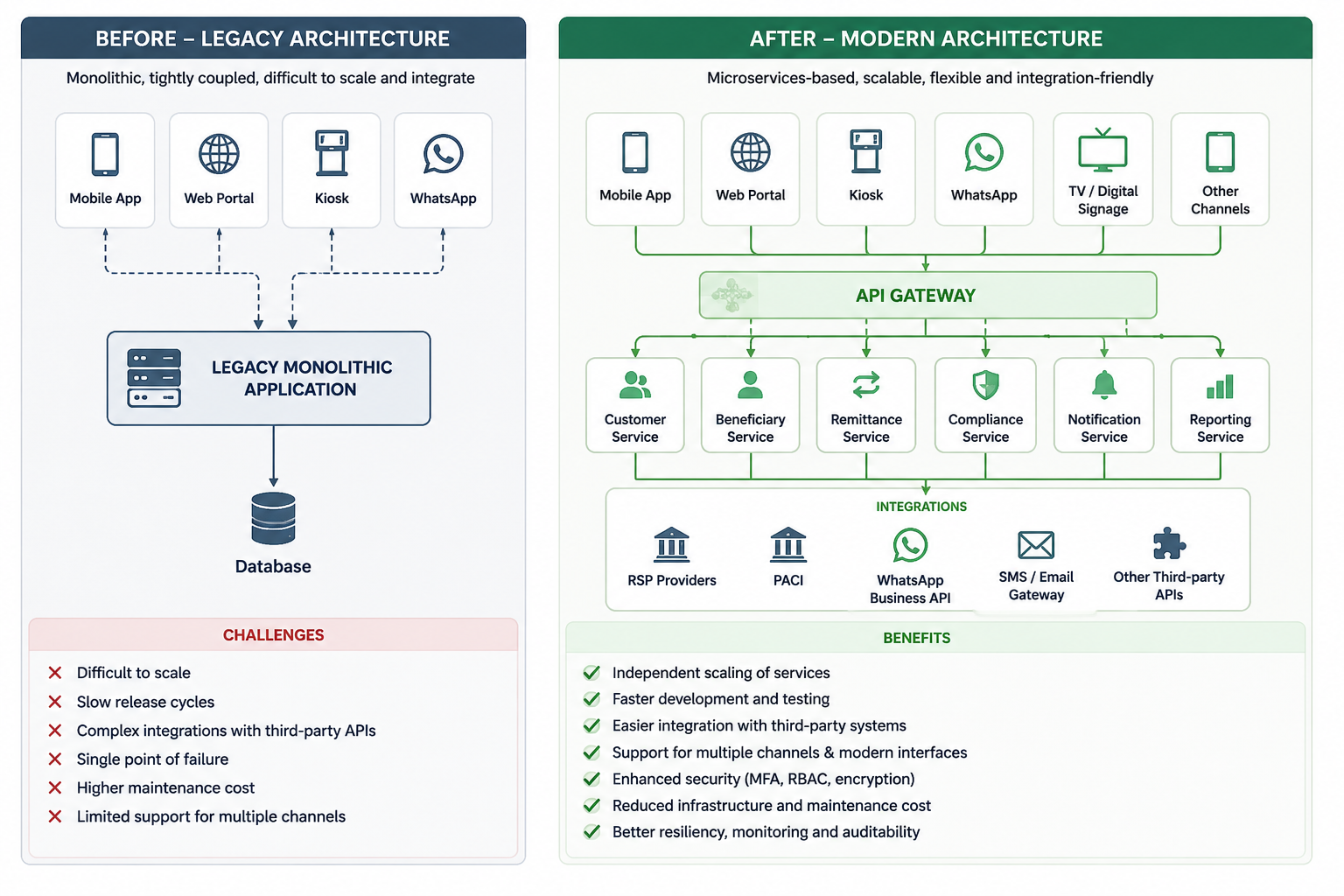
A leading GCC-based exchange house had built a strong reputation and customer base over the years. However, the legacy monolithic architecture had become increasingly difficult to evolve in response to changing market demands and modern integration requirements.
Integrating with external service providers and modern APIs was becoming increasingly complex. At the same time, supporting emerging customer channels such as mobile applications, kiosks, WhatsApp, and other digital touchpoints required significant effort and introduced operational challenges.
The organization needed a modernization strategy that would minimize business disruption while enabling faster delivery, better scalability, and future growth.
Solution
After a detailed assessment of the existing platform, we adopted an incremental modernization strategy rather than attempting a risky "big bang" migration.
The transformation program followed an Agile delivery approach and focused on minimizing business risk through phased rollouts.
Modernization Approach
- Evaluate the feasibility of modernizing the legacy platform
- Identify business capabilities and define the target architecture
- Prioritize low-risk modules with minimal business impact
- Prepare design, development, testing, and production rollout plans
- Deploy new services incrementally and validate business outcomes
- Gradually decommission corresponding legacy functionality
- Repeat the process until complete migration from the legacy platform
Since the existing application was built as a monolithic system, a microservices-based architecture was introduced to enable independent development and scalability of business capabilities.
Technical Benefits
- Improved scalability of individual business services
- Faster development and testing cycles
- Simplified integration with third-party systems and service providers
- Enabled support for multiple channels including Android, iOS, kiosks, WhatsApp, and web platforms
- Enhanced security through Multi-Factor Authentication (MFA) and Role-Based Access Control (RBAC)
- Reduced infrastructure and maintenance overhead
- Improved auditability and operational visibility
Business Impact
The modernization initiative delivered significant business value:
- Supported approximately 5x business growth over the transformation journey
- Improved operational efficiency through automation
- Accelerated customer and beneficiary onboarding processes
- Reduced operational costs
- Enhanced compliance and AML processes
- Enabled smoother and faster day-to-day operations
- Created a flexible foundation for future digital initiatives
Outcome
The phased modernization strategy enabled the organization to evolve without disrupting existing operations. By adopting microservices and modern integration patterns, the platform became easier to maintain, faster to extend, and better positioned to support future business growth and digital transformation initiatives.
Ready to Transform Your Platform?
→